Wednesday, January 31, 2018

The Bald-Cypress

       
         In the fall I usually get asked why the evergreens on #12 tee are dying? All the foilage is falling off and this tree and it is an evergreen right?  Something must be wrong with the tree?  This beautiful tree is actually not an evergreen but is deciduous.  It turns a stunning auburn color the fall and is one of my favorites here at Kenmure.

Here is some more information from a fact sheet from Clemson University :

         Bald-cypress (Taxodium distichum) is a native, deciduous conifer and is only one of five conifer species that sheds its needles in the fall (hence, its “bald” namesake). Typically found growing in saturated soils, seasonally flooded areas, swamps and stream banks, the natural range of bald-cypress extends from the Atlantic Coastal Plain in southern Delaware south to Florida, and then west along the lower Gulf Coast Plain to Texas. It naturally grows further inland through the Mississippi Valley to the southernmost reaches of Oklahoma, Missouri, Illinois, and Indiana.

         Surprisingly, this native conifer exhibits urban toughness: tolerance to air pollution, poorly drained, compacted, and dry soils. This versatility and durability has led to its successful cultivation in landscapes, parking lots, and streetscapes. Mature Height/Spread In the wild, bald-cypress can become a large tree attaining a height of 100 to 150 feet and a few hundred years of age. The largest known individual in SC is in Congaree National Park in Richland County where the “SC Champion” is 127 feet tall, 50 feet wide, and a circumference of 26 feet (July 2002 measurements). Other towering stands of bald-cypress can be found in the Francis Beidler Forest in Harleyville, SC.

        Most landscape specimens tend to grow 50 to 70 by 20 to 30 feet high and wide. Young trees develop a narrow to broadly pyramidal crown; with age the crown becomes broad and flat-topped. Growth Rate Bald-cypress (USDA cold hardiness zones 4a-11) grows moderately fast, generally 1 to 2 feet per year. Although it’s naturally found in floodplains, river channels, and millponds, expect better growth in moist, well-drained soils in full sun.

        Bald-cypress’s two-ranked needles (arranged in two rows on either side of a narrow stem) leaf out chartreuse in the spring and mature to light green in early summer. In the fall, the branchlets of stems and leaves change to tan and then turn orange to reddish-brown before they are shed.
   
        The gray-brown to red-brown bark exfoliates--peels away--in long, vertical strips. As a bald-cypress ages, its trunk becomes fluted and unusually thick or buttressed at its base. Its round, green cones (¾ to 1inches across) are green in summer and then turn brown as they mature in fall and winter. Baldcypress cones are reminiscent of the cones of the giant coastal redwoods of California (Sequoia sempervirens), which are members of the redwood family (Taxodiaceae).
       
        Bald-cypress and its cultivars make a fine standalone specimen or accent planting. They can be clustered together to create a grove or copse, planted near water features or along shorelines, planted as deciduous hedges or screens between properties, or in border plantings along driveways. Expect light, dappled shade from its delicate, feathery foliage.
     
       Bald-cypress has been successfully used as a street tree and in parking lot plantings in many municipalities, including Mt. Pleasant, Sumter, Columbia, and Easley, SC.
     
      Bald-cypress is relatively maintenance-free and requires pruning only to remove dead wood and unwanted lower branches which persist on the tree.

Thursday, November 16, 2017

Our Rough

Hitting your ball out of the rough can be very challenging here at Kenmure.  Our rough is a mixture of Creeping Bentgrass, Annual Bluegrass, and Tall Fescue.  The dominant species is Creeping Bentgrass and it makes up 80% of the Rough that immediately surrounds the greens, tees, and fairways. Creeping Bentgrass can be very thick due to its growth habit, and when it gets 3 inches deep it can be very challenging.

The mowers are set to cut the grass at a height of 2.25 inches.  We attempt to mow the rough two times per week during the growing season.  Weather conditions (Rainfall)  always changes the mowing schedule.  Having Monday available to mow the rough is critical to completing two mowing cycles in one week.  Having the course available to mow while it is closed allows us to move quickly through the golf course uninterrupted.

We always start Monday morning being behind schedule on the rough, this is due to the fact that we do not operate the rough mowing units on the weekend.  This makes Monday a very critical day, we attempt to mow as much of the rough on Monday as possible.  Sometimes we cannot mow on Monday due to rainfall during the day or from the previous night.  This means we will start on Tuesday, and the rough has been growing for 3 days without being cut at all!  At certain points during the year the grass will grow one inch or more during these three days. This seems to happen many times a year here.

The only way to keep up during rain events is to work plenty of overtime on the days when conditions are favorable to mow, sometimes leading us to mow rough until near dark on some nights.  If the rough is very deep we must wait to mow until the dew is gone, or the grass clippings will clump very badly and leave a mess.  This means we also lose a couple more hours in the morning.  This is not a problem for us in the Summer when the daylight lasts until 9:30 pm.  Having dedicated staff willing to work long hours during the mid-season is critical to providing the conditions that we have here at Kenmure.

During the months of October and November before the hard freeze, the grass is still growing vigorously and we do not have the luxury of 3-4 extra hours of daylight to make up lost time from rainfall.  When we have wet conditions during this time of year we can sometimes struggle to get all the rough cut in a timely fashion, getting behind and not catching up with all the grass until Thursday or Friday.  This would mean that you might have encountered some difficult shots out of some areas on Tuesday and Wednesday.

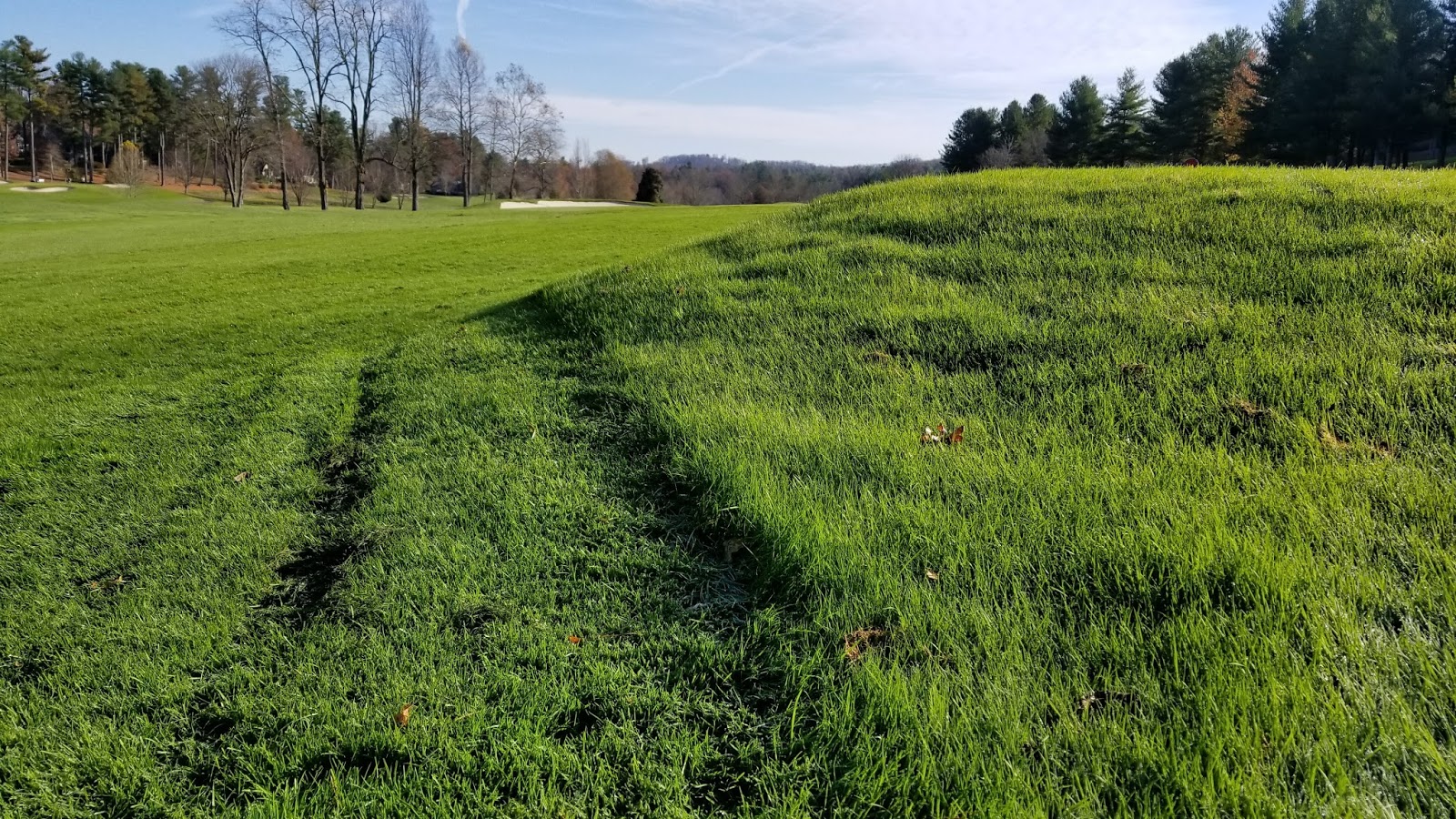
Take for example this picture I took this morning (Nov 11, 2017).  This clearly illustrates how drastic the difference between cut and un-cut grass in the Rough can sometimes be:


Trying to keep on schedule with mowing, while minimizing clippings is something that is on my mind constantly during the growing season.  Every single week of every year always brings different challenges to this schedule, we adapt and restructure constantly to try and stay caught up with whatever the current climate conditions bring us.


Are you missing out on Kenmure Golf Maintenance news?


Did you know the Kenmure Golf Maintenance Dept. has a facebook page that we maintain?

Did you know that since the start of 2017 we have updated this facebook page 73 times?

If you have never visited our facebook page before please know that you are missing out many pictures, videos, and interesting articles about Kenmure Golf Club and the work that we do here.

Please follow this link to visit and view some of the many sights and sounds of our maintenance operation here at Kenmure Country Club:


https://www.facebook.com/kenmuregolf/


I would encourage everyone to go and check out this link.  Please note that you do not need to create an account with Facebook to view these pictures, video, and information.  Please bookmark the site and check it often.


Monday, April 24, 2017

Cart Path Only

Please consider these facts about allowing cart traffic on the turf:


1.  We strive to have as many "off path" days as possible here a Kenmure.

2.  The weather is the major factor in making the decision to allow carts on the fairways.

3.  Twice a year the fairways are closed to cart traffic following fertilizer applications.

4.  Having "Cart Path Only" days protects our large investment in time and money in the golf course.


It is the sincere wish of the golf maintenance staff to provide our membership with high quality playing surfaces.  Restricting cart traffic at the proper times is an important management tool that can contribute greatly to the overall condition of the turf as the season progresses.  Thank you for understanding the choices that we must make.


A very recent article published by the USGA.

http://www.usga.org/content/usga/home-page/course-care/forethegolfer/2017/why-are-carts-occasionally-restricted-to-cart-paths.html


Monday, March 27, 2017

Greens Aerification Video

I edited together some videos of the aerification process.


Friday, March 17, 2017

Pond Dredging on Hole #5

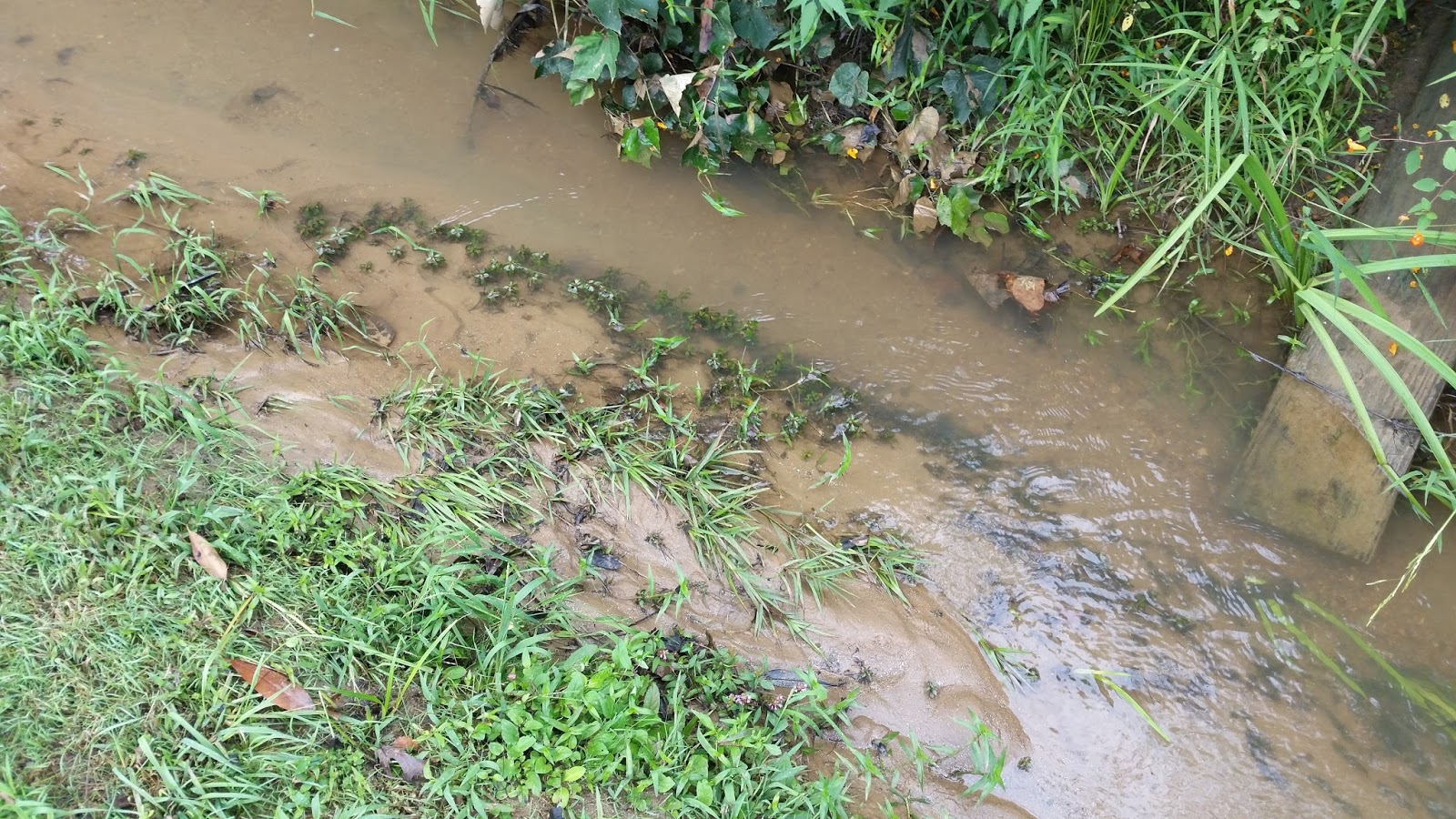
The upper end of the pond on #5 has been slowly filling with sediment from silt contamination that has washed down the stream and into our pond.  This is a slow process but it has really come to the surface in the last number of years.  The pictures below illustrate the problem and what we did to remove the silt.


Pictures from 2014

Even a small stream like this can carry tons of silt.

A closer view of the silt washing in after a rainstorm.

Cumulative effects in our miniature "Delta" region. 

Look at the silt flowing out.

Over the next couple years this area becomes very shallow.


Pictures from 2017

The pond has been drained to start the project.

This end had become completely contaminated and was no longer part of the pond.

A view of the rest of the pond.

The muddy work has begun.


The excavator is sitting on a platform to keep from sinking.
He moved these platform sections all around the pond to do the work.

Concrete was placed in many sections of the spillway to reinforce.

Getting close to finishing.

Deep in the mud,.

Pits were dug to hold the silt and let it dry.  Once these pits dry out they will be covered up.

A look a the new upper section of the pond.

Loading up the platforms at the end of the job.

Video from the pond dredging on Hole #5